
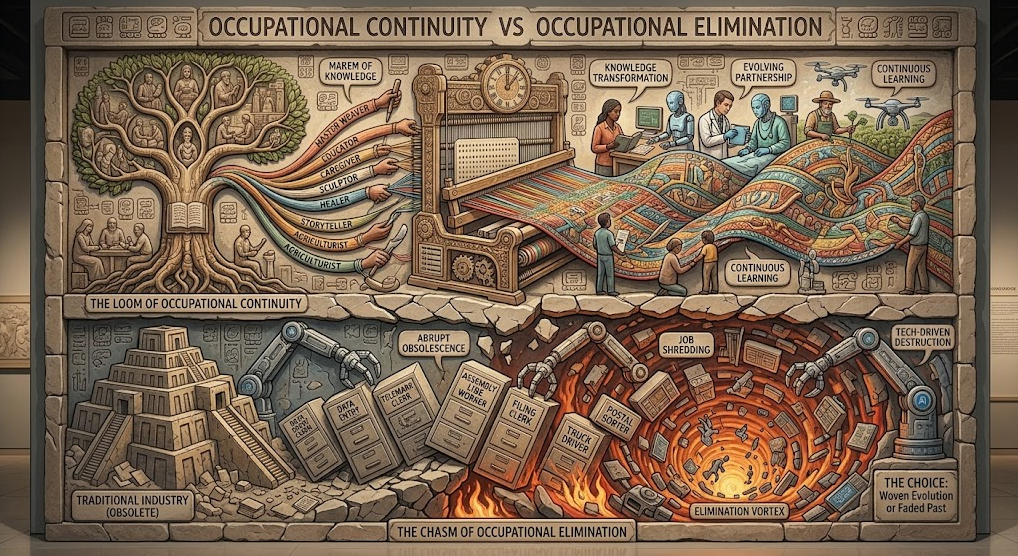
In the First, Second, and much of the Third Industrial Revolution, technology primarily transformed how workers performed their existing occupations, not whether those occupations continued to exist.
The Fourth Industrial Revolution increasingly threatens the occupation itself.
The Great Difference: Occupational Continuity Vs Occupational Elimination
The defining feature of previous industrial revolutions was not that jobs disappeared.
It was that workers often remained within the same broad occupation while adopting new tools.
The defining feature of the Fourth Industrial Revolution is that the technology increasingly performs the occupation itself.
The First Industrial Revolution: The Farmer Remained a Farmer
Before mechanization:
- Farmers used hoes
- Farmers used oxen
- Farmers used manual labor
After mechanization:
- Farmers used tractors
- Farmers used harvesters
- Farmers used mechanical equipment
The farmer did not become a software engineer.
The farmer remained a farmer.
Technology augmented agricultural productivity.
It did not eliminate the need for farmers altogether.
The occupation survived.
The tools changed.
The Weaver Remained a Weaver
Before mechanized textile production:
- Weavers worked manually
- Production was slow
After mechanization:
- Weavers operated looms
- Weavers supervised machinery
Many workers remained within textile production.
Their role evolved.
Their occupation remained recognizable.
The machine multiplied human output.
It did not fully substitute for human participation.
The Blacksmith Became a Machine Operator
Even when occupations transformed significantly, there was often continuity.
The blacksmith of the pre-industrial era frequently evolved into:
- Metal workers
- Tool makers
- Factory mechanics
- Machine operators
The knowledge base remained related.
The worker moved along a recognizable occupational pathway.
The Second Industrial Revolution: Augmented Production
The Second Industrial Revolution introduced:
- Electricity
- Assembly lines
- Mass production
Yet workers remained:
- Factory workers
- Mechanics
- Technicians
- Electricians
The automobile industry did not eliminate workers.
It reorganized workers.
The assembly line increased productivity per worker.
The worker remained central to production.
The Secretary Remained a Secretary
Before computers:
- Secretaries typed documents manually
- Filing was physical
- Communication occurred through letters
After computers:
- Secretaries used word processors
- Email replaced letters
- Digital files replaced paper files
The secretary remained a secretary.
Technology enhanced productivity.
The occupation survived.
The Third Industrial Revolution: Digital Augmentation
The digital revolution transformed many professions.
Consider accountants.
Before computers:
- Ledgers were handwritten
- Calculations were manual
After computers:
- Spreadsheets automated calculations
- Accounting software simplified reporting
Yet the accountant remained an accountant.
The profession survived.
Technology reduced tedious tasks while preserving the professional role.
The Architect Remained an Architect
Before CAD software:
- Architects drew by hand
After CAD software:
- Architects designed digitally
The architect did not disappear.
The architect became more productive.
Again:
Augmentation rather than replacement.
Why the Fourth Industrial Revolution Is Different
The Fourth Industrial Revolution introduces technologies capable of performing the core function of the worker.
This is unprecedented.
Previous technologies mostly automated tasks.
Today’s technologies increasingly automate occupations.
The Call Center Example
Previous revolutions would have given call center workers:
- Better phones
- Better software
- Better databases
The worker remained central.
Today:
AI voice systems can:
- Answer questions
- Resolve issues
- Understand language
- Escalate exceptions
The objective is increasingly not to assist the agent.
The objective is to remove the need for the agent.
The Accountant Example
Previous software helped accountants.
Modern AI increasingly performs:
- Auditing
- Reporting
- Forecasting
- Tax preparation
- Financial analysis
The technology is beginning to compete with the occupation itself.
The Programmer Example
Historically:
Programming tools helped programmers write code.
Today:
AI systems generate code.
The tool is beginning to perform the work it was originally designed to assist.
This represents a profound departure from historical patterns.
The Teacher Example
Traditional educational technologies helped teachers teach.
Today AI can:
- Create lesson plans
- Generate assessments
- Provide tutoring
- Evaluate assignments
The technology increasingly performs educational functions previously reserved for educators.
The Transition Problem for the Global South
Historically, workers transitioned:
· Farmer TO Mechanized Farmer
· Weaver TO Machine Weaver
· Accountant TO Digital Accountant
· Secretary TO Computerized Secretary
· Architect TO CAD Architect
The occupational identity remained largely intact.
The worker upgraded.
The occupation survived.
The Fourth Industrial Revolution increasingly produces a different pattern:
· Call Center Agent TO?
· Data Entry Clerk TO?
· Translator TO?
· Bookkeeper TO?
· Administrative Assistant TO?
· Junior Programmer TO?
The transition pathway is less obvious.
The worker is not simply adopting a new tool.
The worker is competing against the tool.
The Replacement Gap
This creates what may be called the Replacement Gap.
Previous industrial revolutions typically followed:
Human + Machine = Higher Productivity
The Fourth Industrial Revolution increasingly follows:
Machine = Human Function
This difference is subtle but revolutionary.
The goal is no longer merely to make the worker more productive.
The goal is increasingly to make the worker unnecessary.
Why This Matters for the Global South?
The Global South possesses a significant demographic advantage:
- Large populations
- Young populations
- Growing labor forces
Historically, this labor abundance was an economic asset.
But if economic value shifts from labor-intensive production toward autonomous systems, then the development model that lifted many nations may become less effective.
The critical question becomes:
How can developing nations build economies around human augmentation when the dominant technological paradigm increasingly rewards human replacement?
Conclusion
The common claim that “every industrial revolution displaced workers before creating new jobs” misses a crucial historical distinction.
In the First, Second, and much of the Third Industrial Revolution, workers generally remained within their professions while adopting more powerful tools. Farmers remained farmers. Accountants remained accountants. Secretaries remained secretaries. Architects remained architects. Technology enhanced human capability.
The Fourth Industrial Revolution is different because it increasingly automates not just tasks but occupations themselves. Rather than helping workers perform their jobs, it often seeks to perform those jobs on their behalf.
For the Global South, this distinction is profound. The challenge is no longer simply reskilling workers for new tools. The challenge is ensuring that technological progress remains centered on human augmentation rather than human obsolescence. The future of development may depend on whether societies can preserve a meaningful role for human contribution in an age increasingly defined by machine capability.