
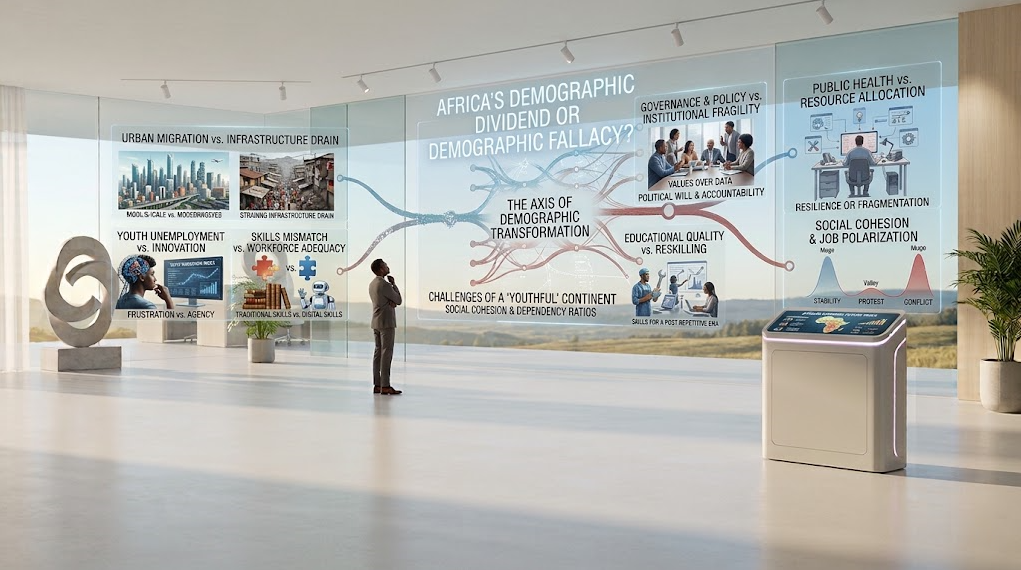
Africa’s Demographic Dividend or Demographic Fallacy?
Why Universities Must Reinvent Education Before 2050
The real dividend of the twenty-first century is not demographic dividend; it is capability dividend.
The Future Workforce Cannot Be Prepared with Yesterday’s Education
The twenty-first century is witnessing one of the most significant demographic shifts in modern history. While many advanced economies are experiencing ageing populations, declining birth rates, and shrinking workforces, Africa is moving in the opposite direction. By 2050, the continent is projected to account for nearly one-quarter of the world’s population and almost one-third of the global working-age population. This unprecedented shift has led many to describe Africa as the world’s next demographic dividend, a youthful workforce capable of driving global productivity, innovation, entrepreneurship, and economic growth.
Yet beneath this optimism lies a more fundamental question:
Does having more people automatically create prosperity?
I argue that it does not.
A large population is not an economic asset by default. It becomes an asset only when people possess the capabilities required to participate meaningfully in a rapidly evolving economy.
Demography creates potential; capability creates prosperity.
This distinction is becoming increasingly important in the age of artificial intelligence.
The Population Advantage Is Not Enough
For decades, economists have celebrated the concept of the demographic dividend, the economic growth that can occur when a country’s working-age population grows faster than its dependent population.
However, this concept often assumes that young people are educated, employable, productive, innovative, and connected to expanding economic opportunities.
That assumption should no longer be taken for granted.
A youthful population without relevant skills, adaptable institutions, or productive employment does not automatically generate economic growth. Instead, it risks creating unemployment, underemployment, social frustration, and widening inequality.
The real question is no longer:
Will Africa have enough young people?
The real question is:
Will Africa have enough capable young people?
From Demographic Dividend to Capability Dividend
The greatest resource of the AI economy is not population.
It is human capability.
Artificial intelligence is transforming industries, occupations, and labour markets at a pace unmatched by previous technological revolutions. Routine work is increasingly automated, while demand is rising for creativity, analytical thinking, systems thinking, digital literacy, innovation, entrepreneurship, and continuous learning.
Simply having millions of young people entering the labour market will not be enough.
The future belongs to societies capable of transforming demographic potential into capability advantage.
In other words:
The real dividend of the twenty-first century is not demographic, it is capability.
Africa’s AI Readiness Challenge
Africa possesses one of the world’s youngest populations.
Yet the continent remains significantly underrepresented in the global artificial intelligence ecosystem.
Although home to a rapidly growing population, Africa contributes only a small share of the global AI workforce. This is not because Africa lacks talent or ambition. Rather, it reflects longstanding gaps in advanced digital skills, research capacity, innovation ecosystems, computing infrastructure, investment, and institutional readiness.
The challenge is therefore not a shortage of people.
The challenge is preparing those people for the economy that is emerging.
Africa is blessed with people.
But it has not yet invested sufficiently in preparing enough of those people for the future of work.
As a result:
Numbers alone do not create prosperity. Competence does.
Universities Are No Longer Just Knowledge Institutions
This reality places universities at the centre of Africa’s future.
For generations, universities have been primarily responsible for producing knowledge and awarding qualifications.
That mission remains important.
But it is no longer sufficient.
Knowledge is becoming increasingly abundant.
Artificial intelligence can retrieve information, summarize research, translate languages, generate code, and assist with countless knowledge-intensive tasks within seconds.
The competitive advantage of universities is therefore shifting.
Their greatest contribution will no longer be knowledge dissemination alone.
Their greatest contribution must become human transformation.
Universities must develop graduates who can:
- solve complex problems;
- adapt continuously to technological change;
- collaborate across disciplines;
- innovate responsibly;
- exercise sound judgment;
- create economic and social value.
The future workforce cannot be prepared with yesterday’s educational philosophy.
The Greatest Risk: A Demographic Fallacy
Without deliberate investment in education, skills, research, entrepreneurship, innovation, and institutional transformation, today’s demographic dividend could become tomorrow’s demographic fallacy, the mistaken belief that population growth alone guarantees economic development.
History shows that prosperity has never depended solely on the number of people a nation possesses.
It has depended on what those people are capable of creating.
A growing population without corresponding investments in capability risks becoming a source of economic pressure rather than economic transformation.
The greatest danger is therefore not population growth itself.
The greatest danger is confusing demographic potential with economic readiness.
Reinventing Education Before 2050
If Africa is to realize its demographic promise, universities must reinvent themselves before demographic realities overtake them.
The future demands institutions that move beyond preparing graduates for existing occupations and begin preparing them for occupations that are still emerging.
This transformation requires universities to become engines of:
- capability development;
- digital literacy;
- AI readiness;
- entrepreneurship;
- interdisciplinary learning;
- research commercialization;
- innovation ecosystems;
- lifelong learning;
- systems thinking; and
- adaptive leadership.
The defining question is no longer:
“How many graduates are we producing?”
The defining question is:
“How many graduates are capable of thriving, creating jobs, solving problems, and competing in an AI-driven global economy?”
Beyond Education: Building an AI-Ready Continent
Reinventing universities alone will not be enough.
Africa’s demographic opportunity also depends on strengthening the broader ecosystem that enables talent to flourish.
This includes:
- expanding digital and computing infrastructure;
- increasing investment in AI research and innovation;
- creating stronger incentives for AI entrepreneurs and startups;
- improving remuneration and career pathways for highly skilled professionals;
- fostering vibrant innovation and entrepreneurship ecosystems;
- strengthening public institutions and governance; and
- building stronger partnerships between universities, industry, and government.
Education is the foundation, but it must be supported by an environment where capability can translate into opportunity, productivity, and inclusive growth.
A New Measure of Success
As countries prepare for 2050, it will no longer be sufficient to celebrate population statistics.
Success will increasingly be measured by questions such as:
- How AI-ready is the workforce?
- How innovative are universities?
- How many graduates create jobs rather than merely seek them?
- How effectively do institutions adapt to technological change?
- How competitive is the country’s knowledge and innovation economy?
These questions distinguish nations that convert demographic potential into sustainable prosperity from those that do not.
Conclusion: The Future Will Be Won Through Capability
Africa’s demographic transition presents one of the greatest opportunities of the twenty-first century.
But demography alone guarantees nothing.
The future will not be determined by the size of Africa’s population.
It will be determined by the quality of its capabilities.
The defining challenge facing Africa is therefore no longer whether it will have enough people.
It is whether it will have enough capable people.
The demographic dividend will not be won in maternity wards alone.
It will be won in classrooms, laboratories, innovation hubs, research centres, entrepreneurial ecosystems, and institutions that prepare people not merely to possess knowledge, but to transform knowledge into capability, innovation, and impact.
By 2050, the world may look to Africa for its largest reservoir of working-age talent.
The question is whether Africa will offer the world its largest workforce, or its most capable workforce.
The answer to that question depends on the choices universities, governments, industries, and societies make today. Only then can Africa’s demographic dividend become a genuine capability dividend, rather than a demographic fallacy.