
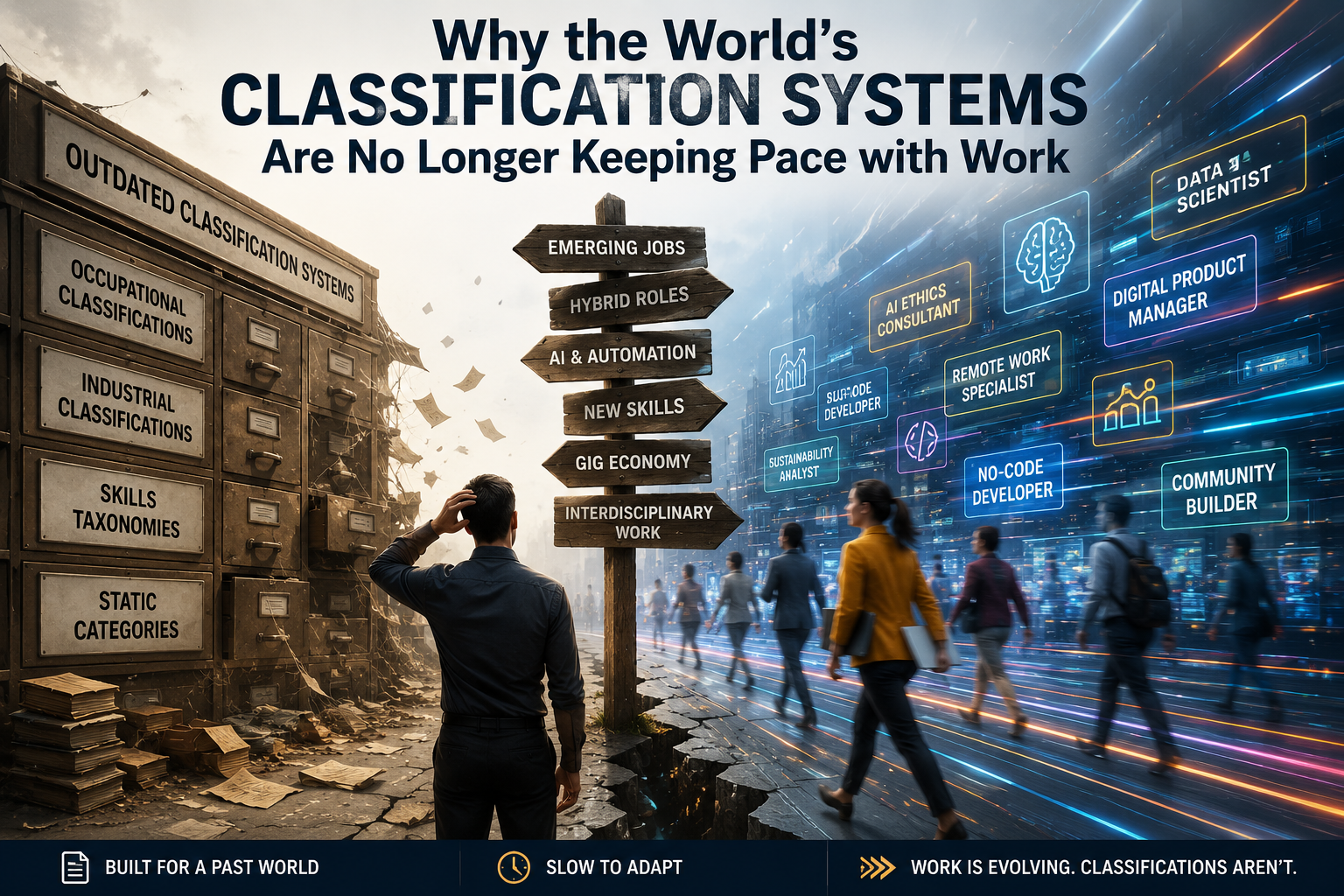
Is AI disrupting the conventional classification systems?
Are Humans Late for Classification 2.0?
The World’s Classification Systems Are No Longer Keeping Pace with Work
The defining question of the AI economy is no longer:
“What occupation is this?”
Classification 2.0 asks:
“What capabilities create value here?”
In the industrial economy, classification organized work.
In the AI economy, classification must organize capability.
For more than half a century, Standard Occupational Classifications (SOC) and Standard Industrial Classifications (SIC) have served as the backbone of labour market intelligence. Governments, employers, researchers, and international organizations have relied on these systems to organize labour statistics, guide education planning, shape workforce policy, inform taxation, and support economic forecasting.
The traditional classification systems have answered two fundamental questions: What work do people do? and What industry do they work in?
The Original Purpose of Occupational classification systems was to create order in labour markets. It assumed that occupations have:
- Clearly defined duties.
- Predictable skill requirements.
- Stable professional identities.
- Distinct industrial boundaries.
For decades, this assumption worked remarkably well because:
- An accountant performed accounting.
- A teacher taught.
- A journalist reported news.
- A software engineer built software.
- Occupations evolved gradually, allowing classification systems to keep pace through periodic revisions.
For decades, these classification systems performed remarkably well because occupations evolved gradually and industries maintained relatively clear boundaries. Job descriptions remained stable, industries were easily distinguishable, and career pathways followed predictable patterns. Classification systems therefore required only periodic revision.
Artificial Intelligence has fundamentally altered this form of classification.
Previous technological revolutions created entirely new occupations.
- The automobile created mechanics.
- Electricity created electrical engineers.
- The internet created web developers.
Artificial Intelligence is doing something more complex.
Rather than replacing one occupation with another, AI is reconfiguring the work inside existing occupations.
- A lawyer now drafts contracts using AI.
- A doctor diagnoses patients with AI-assisted decision support.
- A teacher designs lessons alongside generative AI.
- An architect generates concepts using AI design tools.
- A marketer creates campaigns with AI content systems.
- The occupation remains the same.
- The work has fundamentally changed.
Traditional classification systems struggle to capture this transformation because they classify occupations rather than evolving combinations of human and machine capability.
The World Economic Forum’s Future of Jobs Report 2025, approximately 170 million new jobs are expected to emerge globally by 2030, while around 92 million existing jobs are projected to disappear, resulting in a net employment gain of 78 million jobs. However, beneath these encouraging figures lies a deeper reality: Approximately 39% of workers’ core skills are expected to change by 2030.
The International Monetary Fund (IMF) estimates that Artificial Intelligence will affect nearly 40% of jobs worldwide, with advanced economies experiencing the highest levels of AI integration. Nearly 60% of jobs in advanced economies are expected to be exposed to AI, compared with about 40% in emerging markets and approximately 26% in low-income countries.
The International Labour Organization (ILO) estimates that more than 2 billion people worldwide work in the informal economy, representing nearly 60% of global employment. In Sub-Saharan Africa, informality exceeds 80% of total employment, making workforce planning, occupational measurement, and skills forecasting particularly challenging. Simultaneously, the United Nations projects that by 2050, Africa will account for nearly 25% of the world’s working-age population, positioning the continent as the largest future source of labour globally.
Despite these profound transformations, most governments continue to rely on occupational and industrial classification systems developed for relatively stable industrial economies. Frameworks such as the International Standard Classification of Occupations (ISCO) and the International Standard Industrial Classification (ISIC), the Standard Occupational Classification (SOC) remain the foundation of labour force surveys, censuses, education planning, taxation, workforce policy, and economic forecasting.
Artificial Intelligence is fundamentally disrupting these assumptions.
Occupations are no longer static collections of responsibilities but dynamic combinations of human expertise and intelligent technologies.
Artificial Intelligence is dissolving traditional industry boundaries, increasingly automating individual tasks, redefining professional responsibilities, and creating entirely new occupations faster than official statistical systems can classify them.
Employers are increasingly recruiting for capabilities rather than occupations.
There has been transition from occupation-based economies of industrial-era where taxonomies were built around static occupations and sectors, to capability-based economies where classification 2.0 recognizes that work has become dynamic, interdisciplinary, AI-enabled, and continuously evolving.
Capability increasingly determines employability, calling for classification systems to evolve with AI economy, the one organized around digital capabilities.
Skills such as AI literacy, data literacy, systems thinking, critical thinking, creativity, problem-solving, digital fluency, adaptability, and human-AI collaboration are becoming more important than traditional occupational identities.
By the same token, roles such as Prompt Engineers, AI Governance Specialists, Machine Learning Operations Engineers, AI Auditors, Responsible AI Officers, and Human–AI Collaboration Designers have emerged within just a few years, while many traditional occupations continue to evolve without changing their official titles.
Rethinking Industrial Classification in the AI Economy
Organizations now create value across multiple sectors simultaneously, challenging classification systems that assume each organization belongs to only one industry. Perhaps the most significant transformation is occurring beneath both occupations and industries.
- Universities become technology companies.
- Banks become software companies.
- Hospitals become data organizations.
- Manufacturers become AI developers.
- Retailers become logistics platforms.
- Agricultural firms become precision technology companies.
There is a need for a modern classification framework to classify work across multiple dimensions:
- Occupation
- Skills
- Tasks
- Capabilities
- AI augmentation level
- Automation susceptibility
- Human–AI collaboration
- Industry convergence
- Digital maturity
- Continuous evolution
This raises an important question.
If occupations evolve faster than occupational classifications, industries converge faster than industrial classifications, and capabilities become more valuable than job titles, can twentieth-century classification systems continue to guide twenty-first-century workforce policy?
The solution is not simply to update existing taxonomies but to develop Classification 2.0, a dynamic, AI-enabled, capability-based framework capable of continuously classifying evolving occupations, hybrid industries, human, AI collaboration, emerging skills, automation susceptibility, and interdisciplinary work.
In Conclusion,
Artificial Intelligence is exposing the limits of twentieth-century classification systems. Occupations are evolving faster than taxonomies can classify them. Industries are converging faster than statistical systems can redefine them. Skills are becoming more valuable than job titles, and capabilities are increasingly replacing occupations as the primary unit of economic value. If governments continue to rely on outdated frameworks, labour statistics, workforce policies, education planning, and economic forecasts may no longer accurately reflect the realities of work.
The challenge is therefore not simply to revise existing classification systems. It is to rethink what should be classified in the first place.
The future belongs to labour market systems that measure capabilities rather than titles, tasks rather than occupations, and continuous adaptation rather than static classifications.
The world therefore needs Classification 2.0, a new generation of dynamic, skills-based, AI-aware classification systems that recognize evolving tasks, competencies, hybrid occupations, industry convergence, and human-AI collaboration. Such systems would provide a more accurate foundation for education, labour market intelligence, and economic policy in the age of artificial intelligence.
The question is no longer whether AI will change work. The more urgent question is whether our classification systems can evolve quickly enough to measure, understand, and govern a labour market where occupations are fluid, industries overlap, and human capability, not job title, becomes the defining currency of work.